

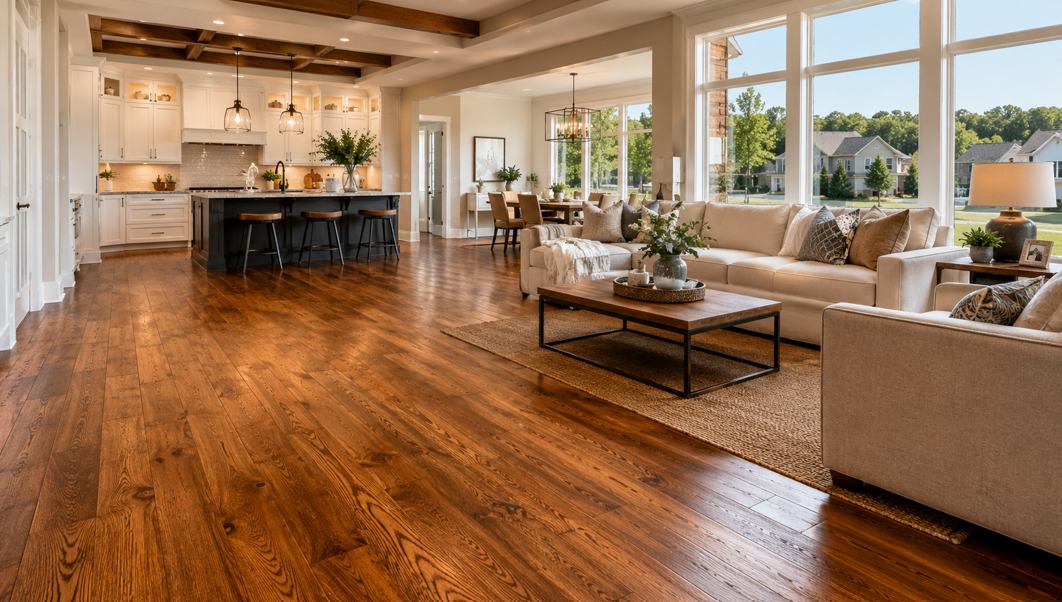
New construction is full of trade-offs. Builders have to balance budget, schedule, buyer expectations, design goals, installation requirements, and long-term performance, often while material and labor costs are moving in the wrong direction.
That pressure is especially relevant in 2026. In July, the National Association of Home Builders reported that builder confidence remained weak, with high material prices, land costs, mortgage rates, and skilled labor shortages continuing to affect the industry. In that environment, every finish has to earn its place in a home.
Hardwood continues to do that.
There is no single public survey showing exactly what percentage of Missouri homebuilders specify hardwood instead of laminate, luxury vinyl, tile, or carpet. But national buyer research, flooring-industry data, and regional market signals help explain why real wood remains part of the conversation. A 2026 flooring trends report cited by Better Homes & Gardens found that 61% of Americans value wood flooring when buying or remodeling a home. A Missouri hardwood supplier also reported that white oak flooring sold particularly well during 2025, with white oak showing stronger demand than red oak in its experience.
For builders, the appeal is not based on one feature. Hardwood combines real-material character, design flexibility, long-term serviceability, and buyer recognition in a way that alternatives do not reproduce in exactly the same manner.
Flooring Galaxy works with flooring projects throughout the St. Louis area, with showrooms in Brentwood, Arnold, and St. Peters. For builders, remodelers, and buyers comparing materials, seeing flooring in person can make it easier to judge color, grade, plank width, texture, and construction before a specification becomes part of the finished home.
Why does hardwood still make the cut when there are so many alternatives? The answer comes down to where builders want to create value and how they expect the home to perform over time.
Real Wood Still Carries a Distinct Material Appeal
A high-quality visual can imitate wood convincingly, but hardwood offers something different: the visible surface is actual wood.
The National Wood Flooring Association defines a wood floor as a flooring product with real wood as its top-most wearable surface. Its definition covers solid wood, engineered wood, and composite engineered wood products that meet that basic real-wood surface requirement.
That distinction matters in homes where material authenticity is part of the design story.
Natural Variation Is Part of the Look
Real wood does not repeat in exactly the same way from plank to plank. Grain movement, mineral streaks, knots, color shifts, and other natural characteristics create variation that comes from the material itself.
For builders designing custom homes, semi-custom homes, or upgraded finish packages, those details can help a floor feel intentional rather than purely decorative.
White oak is a strong example. Its versatile appearance can work in interiors that lean traditional, transitional, contemporary, or organic modern. It can be finished light and natural, warmed with honey or brown tones, or given deeper color for a more formal effect.
That flexibility helps builders use one material category across very different design briefs.
Wood Can Age With the Home
Many building products are selected with future replacement in mind. Hardwood can offer another path.
Depending on the flooring construction, thickness, condition, and finish system, a wood floor may be recoated or refinished when the surface eventually shows wear rather than requiring complete replacement.
That serviceability can be attractive in homes intended to remain desirable for decades.
Not every engineered hardwood floor has the same refinishing potential. Wear-layer thickness and manufacturer guidance matter, so builders benefit from checking the specific product rather than assuming that every wood floor can be treated identically.
Buyer Recognition Gives Hardwood Staying Power
Builders do not choose finishes in a vacuum. They also think about what buyers notice when they walk into a home.
Hardwood has a long-established place in residential interiors, and that familiarity can help it communicate quality quickly.
Resale Research Supports the Appeal
The National Association of REALTORS® has reported strong resale value associated with hardwood projects. Based on its 2022 Remodeling Impact Report, new wood flooring was associated with an estimated 118% cost recovery. The research also found high homeowner satisfaction with hardwood-related improvements.
Those figures come from remodeling research. They are not a guarantee of a specific return for a newly built Missouri home, and market conditions vary considerably.
Still, the findings help explain why hardwood can be viewed as more than a decorative upgrade.
A builder using wood in visible areas such as the foyer, main living space, dining area, or open kitchen may be creating a finish buyers already recognize and understand.
Hardwood Can Differentiate an Upgrade Package
Luxury vinyl and laminate can deliver attractive visuals and practical performance. Their quality has improved considerably, which makes them appropriate choices for many homes.
That can also make real hardwood a clearer point of differentiation in a premium package.
A builder does not have to use wood in every room. Main-level living areas might feature hardwood while bedrooms use carpet, bathrooms use tile, and utility areas use another material selected for the conditions.
This allows hardwood to create visual impact without forcing one flooring category throughout the entire house.
Hardwood Offers Design Flexibility Across Missouri Home Styles
Missouri housing is not one design type. Around the St. Louis area alone, builders may be working with traditional suburban homes, infill developments, historic renovations, townhomes, and open-plan new construction.
Hardwood can adapt to all of them.
Plank Width Changes the Character
Narrower boards can support a more traditional appearance, while wider planks can create a cleaner, more expansive visual.
In 2026, wide wood formats and warmer tones continue to receive attention in residential design. That does not mean every builder needs to follow a trend. It means the hardwood category gives designers room to respond to current preferences without changing the underlying material.
Finish and Texture Add Another Layer
Builders can shape the final look through choices such as:
Matte or low-sheen finishes
Smooth or wire-brushed textures
Light natural tones
Medium warm browns
Richer dark finishes
Character grades with more visible knots and variation
Cleaner grades for a more restrained appearance
The same wood species can create very different interiors depending on these choices.
That versatility can be useful when builders want flooring to complement the architecture rather than dominate it.
Solid and Engineered Hardwood Give Builders Different Options
“Hardwood” does not describe one construction.
Solid hardwood is made from a single piece of wood. Engineered hardwood uses layered construction, while still providing real wood as the visible surface. The NWFA specifically distinguishes solid and engineered products within its definition of real wood flooring.
Each construction can bring different advantages to a building project.
Engineered Hardwood Can Expand Installation Choices
Engineered construction can offer dimensional stability that is useful in certain installations and environmental conditions.
Depending on the specific product, engineered hardwood may also support installation methods or subfloor situations that differ from those used with traditional solid flooring.
That flexibility is useful, but it does not make moisture irrelevant.
Wood still responds to its surrounding environment. Slab conditions, subfloor moisture, indoor humidity, installation method, and manufacturer requirements all need attention.
Solid Hardwood Brings Traditional Serviceability
Solid wood remains attractive where its construction and installation requirements fit the project.
The NWFA's current installation guidance notes that solid wood flooring can generally be sanded and refinished numerous times during its service life, while also advising that below-grade installation requires specific manufacturer approval.
The decision is not about declaring solid or engineered hardwood universally better.
Builders get stronger results by matching the construction to the building, room, subfloor, and long-term expectations.
When comparing hardwood flooring, look beyond species and stain. Construction, wear layer, finish, board dimensions, approved installation methods, warranty terms, moisture requirements, and maintenance can all influence whether a product belongs in a particular build.
Long-Term Value Can Matter More Than First Cost
Builders are working under real affordability pressure in 2026. In July, NAHB reported that 37% of surveyed builders had cut prices and 63% were using sales incentives. The same report identified material costs, land costs, mortgage rates, and skilled labor shortages among the pressures affecting the industry.
That makes upfront price impossible to ignore.
Still, first cost is not the only way to evaluate a floor.
Lifecycle Thinking Changes the Comparison
The National Wood Flooring Association highlights a life-cycle cost analysis originally commissioned by the Tile Council of North America that compared 18 flooring types across a 75-year period in a typical office building.
In that analysis, solid and engineered wood were among the flooring categories with lower annualized costs once factors such as installation, maintenance, and replacement were taken into account.
A commercial lifecycle study is not a direct forecast for a Missouri home. Residential traffic, care, installation conditions, and replacement patterns differ.
The broader principle is still useful: a finish with a higher initial price can make economic sense when its service life and renewal potential are considered alongside the purchase price.
Refinishing Can Extend the Design Life
A flooring color that feels current in 2026 may not be what a homeowner wants twenty years from now.
With a refinishable wood floor, a future owner may have the option to refresh the surface or change the tone instead of replacing the flooring entirely.
That ability can extend both the practical and aesthetic life of the material.
Engineered hardwood needs sufficient usable wear layer for refinishing, and every floor needs to be evaluated according to its construction and condition. The NWFA operates a specific Engineered Refinishable certification program, reinforcing that refinishing potential is a product characteristic rather than something builders can assume across the category.
Hardwood Can Balance Timelessness With Current Trends
Trend-driven finishes create a challenge in new construction. Buyers want homes to feel current, but builders do not want expensive permanent finishes to look dated quickly.
Hardwood can sit comfortably in the middle.
Warm Woods Feel Current Without Feeling Temporary
Warm natural wood tones are receiving renewed attention in 2026, but oak, brown, honey, and natural finishes are not inventions of this design cycle.
That gives builders room to respond to current preferences without relying on a highly specific flooring style that could be more difficult to coordinate later.
A natural or medium-toned hardwood floor can work with changing paint colors, furniture, lighting, and cabinetry over time.
Wood Coordinates With a Wide Range of Materials
Hardwood can work naturally alongside:
Painted or natural-wood cabinetry
Stone and quartz surfaces
Brick fireplaces
Metal fixtures and accents
Area rugs
Upholstered furniture
Tile in moisture-prone areas
For spec homes, that versatility can simplify design decisions.
The flooring can provide a consistent foundation while lighting, paint, furniture, and decorative finishes add more trend-specific personality.
Alternatives Still Have Important Advantages
Choosing hardwood does not require pretending every alternative is inferior.
Builders often use several flooring materials within the same home because each category can solve a different problem.
Luxury Vinyl
Luxury vinyl can offer strong moisture resistance, easy maintenance, and convincing wood-inspired visuals.
It can be particularly practical in rooms where water exposure, household messes, or budget priorities make those characteristics more important than having a real wood surface.
Laminate
Modern laminate can provide detailed wood-look visuals and durable wear surfaces at a different price point from many real wood floors.
Some laminate collections also offer enhanced moisture protection. Builders need to compare individual specifications because performance varies from one product to another.
Tile
Porcelain and ceramic tile are natural candidates for spaces where water resistance and a hard-wearing surface are priorities.
Bathrooms, laundry rooms, mudrooms, and entries are common examples.
Carpet
Carpet provides softness, warmth, sound absorption, and comfort underfoot.
Bedrooms, upper levels, and family-focused spaces can still benefit from those qualities.
A Thoughtful Builder Uses Each Material Where It Works Best
The most effective flooring specification is not necessarily one material stretching from the front door to every corner of the home.
Hardwood might define the primary living spaces while other products handle wet rooms, bedrooms, or utility areas.
That approach preserves the design and buyer appeal of wood while taking advantage of other flooring categories where their specific strengths make more sense.
Missouri Conditions Make Product Selection Important
Missouri goes through significant seasonal weather changes, and indoor conditions can shift with heating, cooling, humidity, and outdoor temperatures.
Because wood responds to moisture in its environment, builders need to consider those changes before installation.
Moisture Planning Starts Before the Floor Goes Down
Successful hardwood installation depends on the full environment, including:
Subfloor conditions
Moisture testing
HVAC operation
Product acclimation when required
Expansion requirements
Installation method
Manufacturer instructions
A premium flooring product cannot compensate for unsuitable job-site conditions.
Scheduling matters in new construction too. Flooring needs to enter the project at the appropriate stage, when the building conditions meet the requirements of the product and installation system.
Professional Installation Protects the Specification
The floor a buyer sees at closing reflects more than the product selected earlier in the build.
Subfloor preparation, layout, transitions, board placement, installation technique, and attention to manufacturer requirements all influence the finished result.
Builders benefit from coordinating flooring decisions early enough for the product, construction schedule, site conditions, and installation team to align.
What Builders Can Ask Before Specifying Hardwood
Choosing hardwood becomes easier when the specification is based on practical questions rather than appearance alone.
Builders, designers, and project teams can ask:
Is solid or engineered construction better suited to the site?
What moisture conditions does the manufacturer allow?
Which installation methods are approved?
How durable is the finish for the intended room?
Can the floor be refinished later?
What is the wear-layer thickness on an engineered product?
How much natural variation can buyers expect?
What maintenance will the homeowner need to follow?
What warranty applies?
Is the product available within the project schedule?
Availability deserves particular attention in construction.
A flooring selection may work beautifully on a design board but still create problems if supply does not align with installation timing. Current affordability and material-cost pressures make early planning especially valuable for builders trying to avoid unnecessary substitutions or delays.
Working with flooring professionals who can explain construction differences, availability, installation requirements, and suitable alternatives can make the specification process more informed.
Why Hardwood Remains Part of the Builder Toolkit
Hardwood does not win every flooring comparison, and it does not need to.
Its value comes from a particular combination of qualities: authentic material, recognizable buyer appeal, broad design flexibility, potential serviceability, and natural character that can work across decades of changing interiors.
That combination helps explain why real wood remains relevant even as laminate, luxury vinyl, tile, and other alternatives continue to advance.
For Missouri homebuilders, the decision is ultimately project-specific. A starter home, luxury custom build, urban renovation, and family-focused suburban property may all call for different flooring strategies.
Hardwood makes sense when real wood supports the buyer expectations, budget, room conditions, design direction, and long-term positioning of the home.
Flooring Galaxy is an independent, family-owned flooring retailer serving the St. Louis area from Brentwood, Arnold, and St. Peters. With hardwood options, professional installation, and the ability to compare flooring in person, builders and homeowners can evaluate the material alongside alternatives rather than making a decision from appearance alone.
If you are planning flooring for a new build or renovation in the St. Louis area, get in touch with Flooring Galaxy to compare hardwood products, constructions, finishes, and installation options for your project.


