

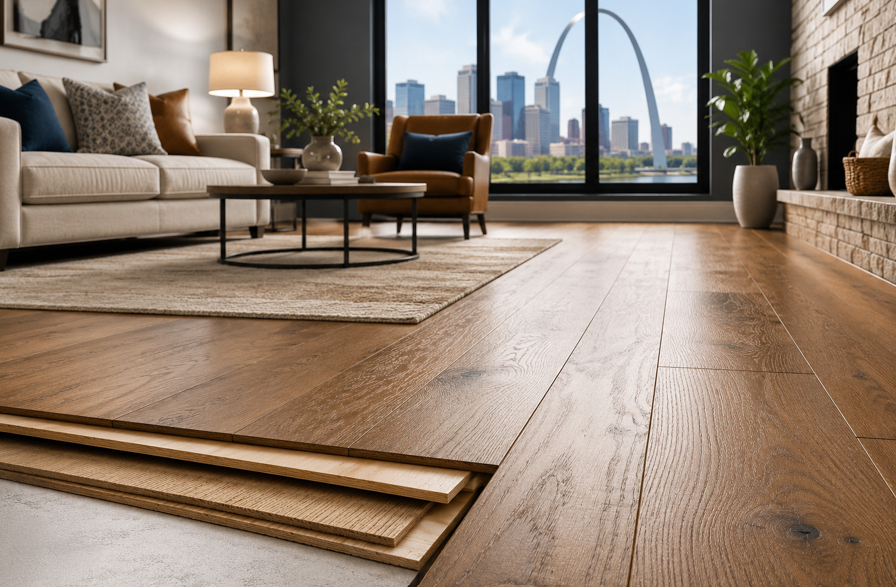
Engineered hardwood gets talked about in ways that can make it sound like either a perfect flooring solution or a compromise. Neither view tells the whole story.
For St. Louis homeowners, the better question is whether engineered hardwood fits the room, the home, and the way the space is used. It is real wood flooring, but its construction differs from solid hardwood. That difference affects stability, installation options, refinishing potential, price, and where the floor may perform best.
The National Wood Flooring Association defines engineered wood flooring as real wood from top to bottom, normally built from multiple wood veneers or slats arranged in opposing directions. It also distinguishes that from composite engineered wood flooring, which has real wood on the wearable surface but may use other composite materials beneath it.
At Flooring Galaxy, St. Louis-area homeowners can compare hardwood options in person at locations in St. Peters, Brentwood, and Arnold. The company also offers shop-at-home service for customers who want to view samples in their own lighting and alongside existing finishes.
So, what is true about engineered hardwood and what is just a flooring myth? Here is a practical breakdown.
What Engineered Hardwood Actually Is
Before sorting through the myths, it helps to understand the product itself.
How the Construction Differs From Solid Hardwood
Solid hardwood is made from one piece of wood from top to bottom. Engineered hardwood uses layered construction.
Depending on the product, the upper surface may be a hardwood wear layer over plywood, wood veneers, or another engineered core. The visible surface is real wood, which means the grain, color variation, knots, and character come from the wood itself rather than from a printed wood-look image.
This layered construction is one of the reasons engineered hardwood behaves differently from solid wood when indoor conditions change.
Why Layered Construction Matters
Wood naturally responds to moisture in the surrounding environment. It can expand when it gains moisture and contract when it loses moisture.
Engineered construction is designed to improve dimensional stability by arranging layers in different directions. That does not make engineered hardwood immune to humidity or moisture, but it can make certain products more stable than traditional solid boards in environments where conditions fluctuate.
That can be useful in the St. Louis region, where homes experience both humid summer weather and dry heated indoor air during winter.
Engineered Does Not Mean Artificial
One of the biggest misconceptions comes from the word “engineered.” Some shoppers hear it and assume the flooring is the same as laminate or luxury vinyl.
It is not.
The NWFA classifies engineered wood flooring as real wood flooring. The top surface is wood, so the natural appearance and variation are genuine.
Myth 1: Engineered Hardwood Is Fake Wood
This is probably the most common misunderstanding, and it is easy to see why. Flooring categories now include laminate, luxury vinyl, wood-look tile, solid hardwood, and engineered hardwood, all of which can create a wood-inspired appearance.
Engineered hardwood belongs in the real-wood category.
Real Wood on the Surface
When you look at a quality engineered hardwood plank, you are looking at an actual wood surface. That means oak looks like oak because it is oak, not because a design layer was printed to resemble it.
Natural variation is part of the appeal. One plank may show more grain movement than the next. Color can vary slightly from board to board. Depending on the style, you may also see knots, mineral streaks, or other characteristics associated with the species.
Engineered Hardwood and Laminate Are Different Products
Laminate is a separate flooring category with a different construction. It typically creates a wood look through a decorative visual layer rather than a hardwood wear surface.
That does not make one category automatically better than the other. They solve different needs.
Homeowners who want the texture and character of real wood but also value the construction advantages of an engineered product may find engineered hardwood especially appealing.
Myth 2: Engineered Hardwood Always Handles Moisture
Engineered hardwood is often described as more stable than solid hardwood, but that sometimes gets translated into a much broader claim: engineered hardwood is waterproof.
That is not generally true.
More Stable Does Not Mean Waterproof
Layered construction can help reduce some movement associated with environmental changes, but engineered hardwood still contains real wood. Excessive moisture can damage wood flooring.
Spills, leaks, high humidity, slab moisture, and standing water all deserve attention. Product specifications matter, and the requirements for one engineered hardwood may be very different from another.
Think About the Room First
Before selecting engineered hardwood, consider where it will be installed.
A living room, bedroom, dining room, or home office presents different moisture conditions from a bathroom or a basement with a history of dampness.
In below-grade spaces or installations over concrete, the flooring product, subfloor conditions, moisture testing, installation system, and manufacturer instructions all need to line up.
Engineered hardwood may open up installation possibilities that are not ideal for some solid products, but the decision still needs to be product-specific.
Myth 3: Every Engineered Hardwood Floor Can Be Refinished
Another common belief is that because the surface is real wood, any engineered floor can simply be sanded and refinished over and over.
The truth depends heavily on construction.
Wear Layer Thickness Matters
The wear layer is the real wood surface above the core. Its thickness can influence whether refinishing is possible and how much material is available for sanding.
A thicker wear layer may provide more refinishing flexibility than a very thin one. Some engineered products are specifically designed to be refinished, while others may have limited or no sanding potential.
The NWFA even operates an Engineered Refinishable Certified program for qualifying wood flooring, reinforcing the fact that refinishing capability is a product characteristic that needs to be verified rather than assumed.
Ask Before You Buy
If long-term refinishing is important to you, ask:
How thick is the wear layer?
Does the manufacturer say this floor can be refinished?
How many times, if any, does the manufacturer anticipate refinishing?
Does the warranty contain specific care or refinishing requirements?
Is recoating an option before full sanding becomes necessary?
This is a good example of why two engineered hardwood floors that look similar on a sample board may offer very different long-term value.
Myth 4: Engineered Hardwood Is Automatically Lower Quality
“Engineered” describes construction, not quality.
There are basic engineered products, premium engineered products, and plenty in between. Judging the entire category by the least expensive option is like judging every solid hardwood floor by a single entry-level product.
Look Beyond the Species and Color
When comparing hardwood flooring, consider the complete construction rather than choosing only by the surface color.
Useful questions include:
What is the wear layer made from?
How thick is the wear layer?
What type of core construction is used?
What finish is applied?
What warranty comes with the product?
What installation methods are approved?
What room and subfloor conditions are allowed?
What maintenance does the manufacturer recommend?
These details help separate a product that simply looks good in a sample from one that fits your home and expectations.
Manufacturing Standards Matter
The NWFA offers voluntary quality, performance, refinishing, and sustainability programs for wood-flooring manufacturers. Its programs include standards and certifications for solid and engineered wood floors.
That does not mean every worthwhile floor needs to carry the same certification. It does mean shoppers have good reason to ask manufacturers and flooring professionals about construction, testing, warranties, and quality indicators.
Myth 5: Engineered Hardwood Looks Less Authentic Than Solid Wood
Once engineered hardwood is installed, the visual difference between it and solid hardwood may be far less obvious than shoppers expect.
That is because the part you see is real wood.
Species, Grade, Finish, and Plank Size Shape the Look
The overall appearance depends on factors such as:
Wood species
Natural color variation
Grade and character
Stain color
Surface texture
Finish sheen
Plank width
Board length
Installation pattern
A wide-plank engineered oak floor with natural variation can create a very different feeling from a smooth, narrow plank in a deep stain. Both are engineered hardwood, but their design impact is completely different.
This is also why shopping from a small online image can be misleading. Real wood changes visually with lighting and surrounding colors.
See Samples in Your Own Space
If possible, compare several planks rather than one small sample. Look at them near cabinets, wall paint, trim, and furniture.
St. Louis homes range from historic properties with traditional millwork to newer open-plan houses with contemporary finishes. Engineered hardwood is available in styles that can suit both ends of that spectrum.
Myth 6: Engineered Hardwood Is Maintenance-Free
Engineered hardwood may be practical to live with, but it is still a real wood surface. It deserves appropriate care.
Daily Care Can Be Simple
Regular removal of dust, grit, and debris can help protect the finish. Spills are best cleaned promptly, and cleaning products need to match the manufacturer’s recommendations.
Avoid assuming that more water means a deeper clean. Wood flooring and excessive moisture are not a good combination.
Protect High-Use Areas
Simple habits can help maintain the appearance of hardwood:
Use entry mats to reduce tracked-in grit.
Add protective pads beneath furniture legs.
Follow manufacturer guidance for rolling chairs.
Keep pet nails maintained.
Clean spills promptly.
Use approved cleaning products.
Avoid dragging heavy furniture across the floor.
The finish is the first line of defense against everyday wear, so protecting that finish helps the floor stay beautiful longer.
Indoor Conditions Still Matter
Because engineered hardwood contains real wood, indoor humidity and moisture conditions still matter. The construction can provide greater stability than solid wood in some situations, but the floor still needs an environment that fits manufacturer requirements.
Professional product selection and installation planning can help account for those details before the first plank goes down.
Myth 7: Solid Hardwood Is Always the Better Investment
Solid hardwood has real strengths, including its traditional construction and, depending on board thickness and condition, substantial refinishing potential.
But “better” depends on what your home requires.
Engineered Hardwood Can Solve Different Installation Needs
Some engineered products can be installed in situations where a particular solid hardwood product may not be the best fit. Depending on manufacturer instructions, engineered hardwood may support installation methods such as glue-down, nail-down, staple-down, or floating systems.
The approved method depends on the product, subfloor, grade level, and installation conditions.
For homeowners working with concrete slabs or particular remodeling situations, engineered construction can provide useful flexibility.
Long-Term Value Is More Than One Feature
Refinishing matters, but so do:
Product quality
Installation quality
Moisture conditions
Finish durability
Maintenance
Style longevity
Suitability for the room
A floor that fits the home and is properly maintained can be a better purchase than choosing a category based on reputation alone.
Myth 8: All Engineered Hardwood Has the Same Indoor Air Quality Profile
Engineered flooring uses adhesives and manufactured components, so some homeowners have questions about emissions. The right response is not to assume every product is the same.
Check the Product Information
The EPA regulates formaldehyde emissions from certain composite wood products under TSCA Title VI. Covered products include hardwood plywood, medium-density fiberboard, particleboard, and finished goods containing regulated composite wood materials. EPA requirements include emission standards, labeling, testing, recordkeeping, and third-party certification provisions.
For homeowners, the practical takeaway is simple: ask what materials are used in the flooring and what compliance or certification information is available for the specific product.
Do not rely only on broad marketing phrases. Product documentation gives you a better basis for comparison.
Installation Products Matter Too
Flooring is not the only material involved in a project. Depending on the installation system, adhesives, underlayments, moisture-control products, finishes, and other materials may also be part of the assembly.
If indoor air quality is a priority in your household, discuss the full installation system rather than evaluating the plank in isolation.
How to Decide Whether Engineered Hardwood Fits Your St. Louis Home
Once the myths are out of the way, the decision becomes much easier.
Start With the Room
Think about where the floor is going and what happens there every day.
Is it a busy family room? A quiet bedroom? A main-level living area? A condo? A renovation over concrete? A room with direct backyard access?
The conditions help narrow down the right construction, finish, durability level, and installation method.
Think About Your Long-Term Plans
If you want the possibility of sanding and refinishing years down the road, look closely at wear-layer specifications.
If stability or installation flexibility matters more, discuss engineered products designed around those priorities.
If pets and active family life are part of the picture, compare finish performance, texture, color, and care requirements.
Compare More Than One Product
Do not assume all engineered hardwood is interchangeable. Compare products side by side and ask why one costs more than another.
Differences may come from species, wear-layer thickness, core construction, finish technology, plank dimensions, manufacturing standards, warranty coverage, or other features.
A knowledgeable flooring specialist can explain which differences matter for your project and which ones may not.
See Engineered Hardwood for Yourself
The truth about engineered hardwood is straightforward: it is real wood flooring with a layered construction designed to offer characteristics that differ from traditional solid hardwood.
It is not automatically waterproof. It is not automatically lower quality. It cannot always be refinished. It does not all perform the same way. And it certainly does not look “fake” simply because it is engineered.
For many St. Louis homes, those differences can be advantages when the product is matched carefully to the space.
Flooring Galaxy has been serving the St. Louis area as an independent, family-owned flooring retailer, with showrooms in Brentwood, Arnold, and St. Peters. Seeing full-size samples and discussing your subfloor, room conditions, design preferences, and long-term expectations can make it much easier to choose with confidence.
If you are considering engineered hardwood for a renovation or new flooring project, get in touch with the Flooring Galaxy team to compare options and find a floor that makes sense for your home.


