

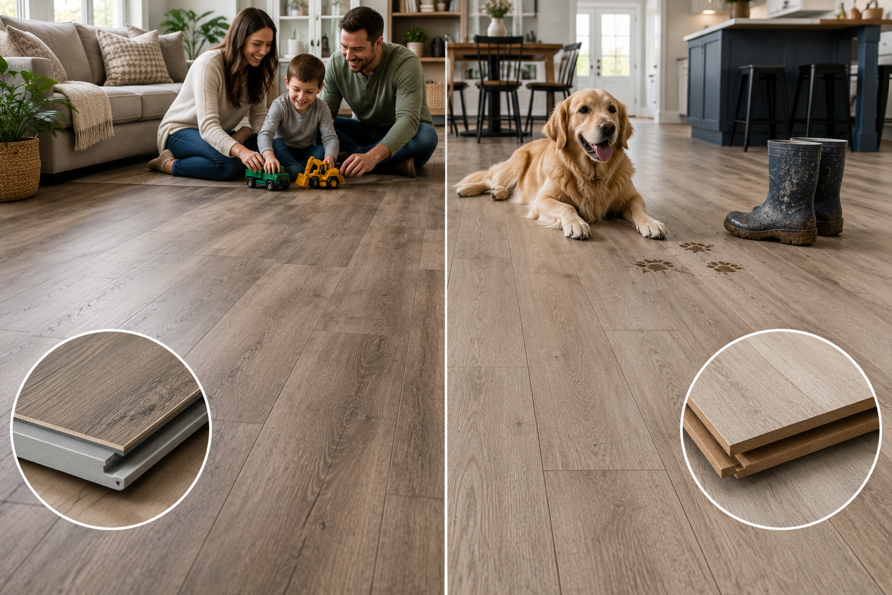
Which Flooring Works Better for a Busy Family?
When school schedules, work, pets, sports gear, groceries, and everyday messes all meet at the front door, flooring has to do more than look good. For busy St. Louis families, the right floor needs to handle foot traffic, spills, scratches, cleaning, and changing seasons without demanding constant attention.
Two options often compared today are hybrid flooring and laminate. Both can deliver realistic wood looks, click-lock installation, and family-friendly durability, but they are not identical.
The short answer is this: hybrid flooring can be a strong fit when water exposure is the biggest concern, while laminate can be an excellent choice when wood realism, surface durability, and overall value are top priorities. Modern waterproof laminate has also narrowed the moisture-performance gap, so the best choice depends on the exact product and the room.
For St. Louis homeowners sorting through those choices, Flooring Galaxy can help compare flooring based on household needs rather than relying on a category label alone.
Before choosing, think about where the flooring is going. A kitchen, basement, playroom, bedroom, and entryway face very different kinds of wear. The floor that works best in one room may not be the strongest choice for another.
What Does “Hybrid Flooring” Actually Mean?
“Hybrid flooring” is not always built the same way from brand to brand. In the U.S. market, hybrid resilient flooring is often positioned as combining laminate-like durability with the waterproof performance associated with resilient flooring. Some current products use wood-based waterproof cores, while others marketed as hybrid use rigid composite constructions. That makes the individual product specification more important than the word “hybrid” itself.
In practical terms, hybrid flooring is usually designed as a floating, click-together floor with a rigid core, decorative wood-look layer, and protective surface. Many products emphasize waterproof performance, scratch resistance, and suitability for high-use rooms.
That combination can be appealing in a busy household because it targets several everyday concerns at once. Still, homeowners should compare the actual core construction, wear surface, warranty, approved rooms, and installation requirements before deciding.
Why Laminate Is Still a Strong Family Flooring Option
Laminate has been around much longer, but today’s products are very different from early generations that were highly sensitive to moisture.
A typical laminate plank uses a dense fiberboard core beneath a decorative image layer and protective wear surface. Modern collections can create convincing oak, hickory, maple, and other hardwood visuals, often with embossed textures that make the grain look and feel more realistic.
Water performance has changed too. Current Pergo laminate collections, for example, include products promoted with waterproof surface systems, water-tight joints, scratch resistance, and pet-related warranty coverage. Those features are product-specific, not universal across all laminate.
For a family that wants a warm wood look in living rooms, hallways, bedrooms, or an open main level, laminate can deliver substantial visual impact and practical everyday performance.
Water Resistance: Which Floor Handles Spills Better?
Water is usually the first comparison families make. Drinks tip over. Dogs come in with wet paws. Kids drop water bottles. Kitchens and mudrooms see more moisture than bedrooms.
Hybrid Flooring Around Water
Many hybrid resilient products are designed around waterproof construction, making them appealing for kitchens, laundry areas, basements, and other spaces where spills are more likely. Some current U.S. hybrid resilient lines are specifically marketed for on-, above-, and below-grade installations.
However, a waterproof floor does not make the entire room waterproof. A major plumbing leak or flood can still affect baseboards, cabinets, walls, and materials beneath the floor.
Laminate Around Water
Traditional laminate required more caution, but modern waterproof collections have changed the category. Some current laminate systems are designed to keep spills at the surface and are promoted for kitchens, bathrooms, pets, and busy family life.
The key word is “some.” When comparing laminate flooring, verify the specific collection’s water rating, approved rooms, warranty, and installation instructions.
For everyday spills, high-quality waterproof laminate may be more capable than many homeowners expect. Where recurring moisture exposure is the main concern, a suitable waterproof hybrid product may have an advantage.
Scratch, Scuff, and Dent Resistance for Kids and Pets
Water is only part of family life. Shoes, toys, backpacks, chairs, pet claws, and grit tracked in from outdoors can all test a floor’s surface.
Laminate has traditionally been strong in abrasion and scratch resistance because its top wear layer is engineered for everyday traffic. Higher-performance collections can also include stain, pet, and scratch-related warranty protection.
Hybrid flooring can also offer strong surface protection. Some hybrid resilient lines are specifically marketed for scratch, dent, and stain resistance in households with children and pets.
So which one wins? There is no category-wide answer. Compare the actual wear rating, scratch warranty, dent resistance, and care guidance of the products you are considering.
For a household with large dogs, active children, or a heavily used entryway, surface performance deserves just as much attention as waterproof claims.
Which One Looks More Like Real Hardwood?
For many homeowners, laminate has a strong reputation for wood realism.
Because laminate has long been designed around wood replication, many collections feature detailed grain images, plank variation, beveled edges, and embossed textures. Better products can create a convincing hardwood-inspired appearance across a large room.
Hybrid flooring has improved quickly and can also offer attractive wood visuals, including wide planks, natural oak colors, matte surfaces, and textured finishes.
The best way to judge either category is to look at several planks together rather than relying on one small sample. A good floor should have enough pattern variation that the finished room does not feel repetitive.
Also view samples in your own lighting. A St. Louis family room with large windows can make a floor look very different from a lower-level room with limited natural light.
Comfort, Sound, and Feel Underfoot
Families notice flooring with their feet as much as their eyes.
Laminate can feel firm and substantial, particularly in thicker products paired with an approved attached pad or underlayment. Some homeowners like that solid response because it contributes to a traditional wood-floor feel.
Hybrid flooring varies by core construction. Certain rigid products feel dense, while others include pads or constructions intended to reduce sound and add comfort.
If noise matters because bedrooms sit below a playroom or the home has a large open layout, compare acoustic specifications as well as thickness.
Avoid assuming extra underlayment automatically improves a floating floor. Manufacturers specify which pads can be used, and an unapproved combination may affect joint performance or warranty coverage.
Which Floor Is Easier to Clean?
Both categories can be practical for busy households.
Routine laminate care generally involves sweeping, vacuuming with a suitable hard-floor setting, and using a manufacturer-approved cleaning method. Hybrid flooring is also typically designed for straightforward sweeping and cleaning.
A few habits can help either floor perform better:
Wipe up spills promptly.
Use mats at exterior doors.
Add protective pads under furniture.
Keep pet nails maintained.
Avoid dragging heavy items across the surface.
Follow the manufacturer’s cleaning directions.
For a family with little time to spare, the easier floor is often the one whose care instructions match the household’s real routine.
St. Louis Weather and Seasonal Changes Matter
St. Louis homes experience humid summers, cold winters, rain, snow, and regular shifts between heating and air conditioning. Those conditions affect indoor humidity and how much moisture is tracked into the home.
Entryways and mudrooms may deal with wet shoes during storms or winter weather. Basements can have different moisture conditions from upper floors. Kitchens see spills, while bedrooms stay comparatively dry.
That is why one flooring category does not automatically need to cover the entire house.
A family might prefer a waterproof hybrid product in a basement or laundry space while choosing laminate for living areas and bedrooms. Another household may choose a waterproof laminate collection across connected rooms to maintain one continuous wood look.
Whichever approach you take, confirm that the exact product is approved for the installation area and follow its subfloor, moisture, expansion, and installation requirements.
Cost and Long-Term Value
Families working within a remodeling budget naturally want to know which option offers better value.
Laminate is often a value-conscious way to achieve a realistic wood look with strong everyday durability. Hybrid flooring can also be competitively priced, although newer or higher-performance constructions may cost more depending on the brand, thickness, wear surface, and attached pad.
The material price is only one part of the project. Compare:
Flooring cost per square foot
Underlayment requirements
Existing-floor removal
Subfloor preparation
Trim and transitions
Professional installation
Extra material for cuts and future repairs
Warranty coverage
A lower-priced product that is poorly suited to the room is not better value. Spending more for the performance feature your household genuinely needs may make more sense over the life of the floor.
Best Rooms for Hybrid Flooring
Hybrid flooring can make sense when water protection is high on the priority list, provided the specific product is approved for the intended space.
Kitchens and Mudrooms
Sinks, dishwashers, wet shoes, umbrellas, sports bags, and pet traffic make moisture protection valuable in these busy areas.
Basements
A hybrid product approved for below-grade use can provide a wood-look surface in a finished basement. Existing seepage, drainage, or flooding concerns still need to be addressed before flooring installation.
Laundry Areas
Waterproof construction can be useful around washing machines and utility spaces, although a large appliance leak can affect more than the floor itself.
The important point is to check the product rather than selecting based on “hybrid” alone.
Best Rooms for Laminate Flooring
Laminate remains a strong option for many spaces where families spend most of their time.
Family Rooms and Open Living Areas
Durable surfaces and realistic wood visuals make laminate a practical fit for rooms with children, pets, furniture, and daily traffic.
Bedrooms
Laminate can create a coordinated wood look while keeping routine care straightforward.
Hallways and Home Offices
Higher-use collections can handle circulation areas, while the firm surface works well with desks and office furniture when appropriate chair protection is used.
Modern waterproof laminate can expand the list further. Always check the specific product’s approved applications rather than treating every laminate collection as one performance level.
Hybrid Flooring vs. Laminate for Pets
Pet owners usually care about scratches, accidents, traction, and cleanup.
Hybrid flooring may appeal because many products focus heavily on waterproof performance. Laminate can be equally attractive for its hard wear surface and scratch resistance, particularly in higher-performance collections.
For dogs, surface texture also matters. A very smooth floor can feel slippery regardless of category, while a more textured finish may provide better footing.
Color deserves thought too. Very dark floors can make light pet hair more visible, while very pale flooring can highlight dark fur and tracked-in dirt.
The practical winner is the product that balances water performance, scratch protection, traction, and a color that works with your cleaning routine.
Hybrid Flooring vs. Laminate for Kids
Children put flooring through a different test. Playrooms see toys, drinks, craft supplies, and constant movement. Dining areas get crumbs and chair traffic. Hallways collect backpacks and shoes.
Hybrid flooring can be a strong option where spills are the primary concern. Laminate can be a strong option where surface wear, wood realism, and value matter most.
For either category, compare:
Scratch and stain resistance
Water protection
Ease of cleaning
Surface texture
Warranty coverage
Approved room use
Comfort and sound
A good family floor is not necessarily the one with the longest feature list. It is the one whose features match what actually happens in your home.
So, Which Is Better for a Busy St. Louis Family?
For most families, there is no universal winner.
Choose hybrid flooring when waterproof construction is one of your highest priorities and the specific product is approved for the rooms you are renovating.
Choose laminate when you want strong wood realism, durable surface performance, broad style choices, and good overall value. Modern waterproof laminate can also be a strong choice for households that want moisture protection without giving up the look they prefer.
For many St. Louis homes, the smarter question is not “Which category is better?” It is “Which product is better for this room?”
A kitchen, basement, bedroom, and playroom do not face the same conditions. Looking at flooring room by room can help families spend where performance matters while keeping the design cohesive.
Find a Family-Friendly Floor That Fits Your Home
Busy families need flooring that can keep up without turning everyday life into a maintenance project.
Hybrid flooring brings strong moisture-focused performance to the comparison, while laminate continues to stand out for realistic wood visuals, durable surfaces, and value. Modern waterproof laminate also means the difference between these categories is no longer as simple as saying one handles water and the other does not.
The right choice depends on your rooms, pets, children, traffic levels, style preferences, and budget.
Flooring Galaxy serves homeowners throughout the St. Louis area, including Brentwood, Arnold, St. Peters, and St. Louis, with experienced guidance, professional installation, and flooring options for different household needs.
If you are comparing laminate with other family-friendly flooring options and want help narrowing down the right fit, reach out to us to talk with the Flooring Galaxy team.


